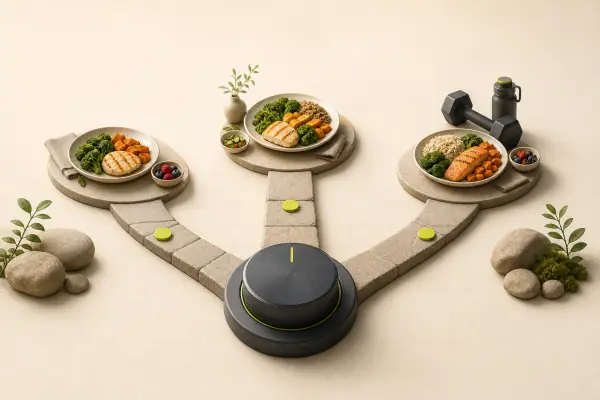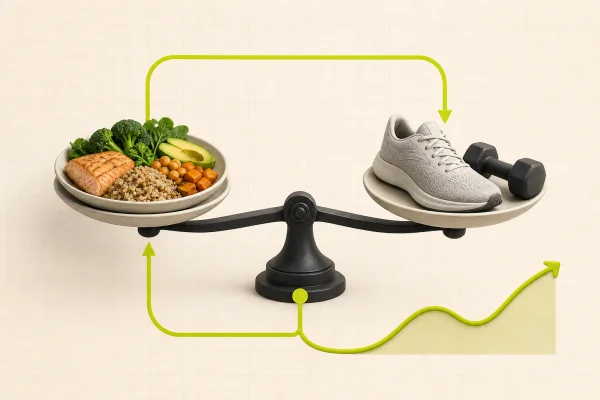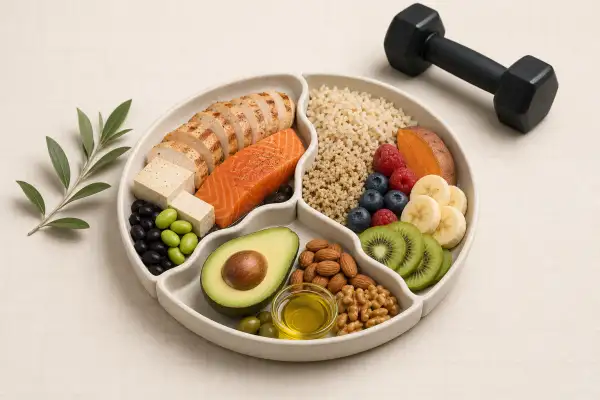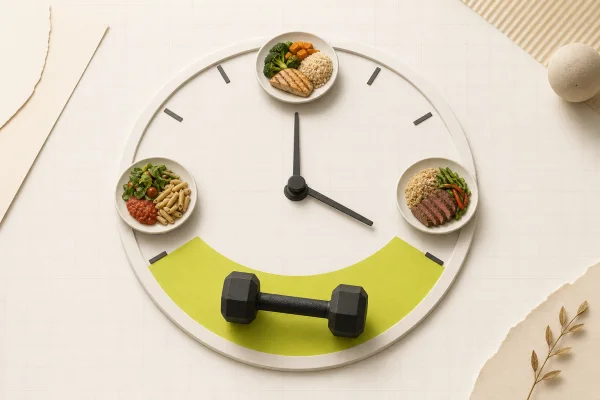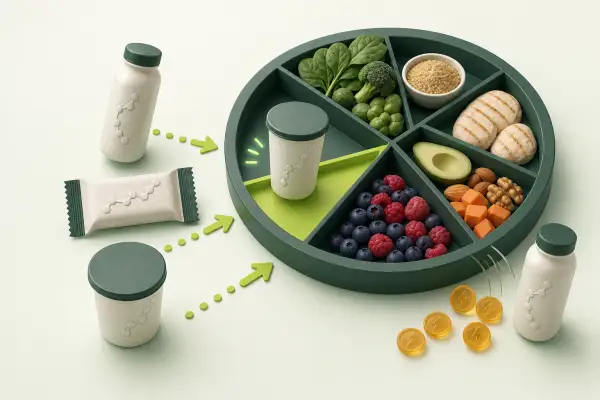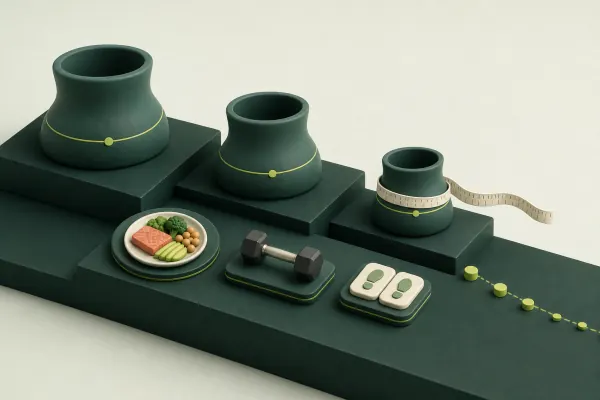
How do you stay motivated to work out? A system that lasts
Workouts, meals, steps, and a backup plan: turn your physique goal into a routine simple enough to survive busy days and low motivation.
Read the guide NALKO
NALKO
The Nalko journal
Clear, evidence-aware, actionable answers to help you train better, eat well, and adjust your plan with data — without miracle claims.
Workouts, meals, steps, and a backup plan: turn your physique goal into a routine simple enough to survive busy days and low motivation.
Read the guideChoose a topic, get the useful answer, then apply it with measurable benchmarks.
Volume, effort, exercise selection, progression, and rest: benchmarks that make a program measurable.
There is no magic rep count: match the range to the exercise, finish hard sets close enough to failure, and progress comparable sets.
Read the guideA deload is not punishment or a mandatory monthly break: look for converging fatigue signals and reduce volume before adding complexity.
Read the guideTreat consistency as a programming variable: build a realistic week, create a minimum plan, and use clear criteria to address what gets in the way.
Read the guideTwo alternating workouts, adaptable movements, and double progression: build your first program so you can follow it, track it, and refine it.
Read the guideBuild each workout around a priority, put exercises in a purposeful order, and let volume, rest periods, and transitions determine its duration.
Read the guideTwo days are often enough, three make balance easier, and four or more mainly help distribute the dose. Decide based on your constraints and performance.
Read the guideCount the sets that truly stimulate the muscle, distribute them without sacrificing quality, and adjust the dose based on your performance rather than a universal number.
Read the guideA daily routine can be light and tolerable, but more days do not guarantee more muscle or less belly fat. Learn how to set the dose and progress.
Read the guideSoreness can signal an unfamiliar stress, not the quality of a workout. Base your decision on the pain, range of motion, technique, and performance that day.
Read the guideLearn the difference between a hard set and a failed rep, then choose how close to failure to train based on your goal, the exercise, and its fatigue cost.
Read the guideBorg RPE, session-RPE, and set RPE do not measure the same thing. Learn how powerlifting, bodybuilding, and gymnastics use them.
Read the guideTreat progression as feedback on program quality: compare truly comparable sets, then increase the demand at the right time.
Read the guidePerformance can improve before your physique visibly changes. Separate the indicators, standardize each measurement, and judge a sufficiently long trend.
Read the guideOne bad workout is not a plateau. Compare genuinely comparable performance, find the limiting factor, and change one variable at a time.
Read the guideFor young people, maturity and supervision matter more than a birthday. For adults, current abilities and gradual progression matter more than starting age.
Read the guideThese disciplines all involve strength and muscle, but they lead to different competitive tests. Borrow their tools without letting their rules choose your goal for you.
Read the guideA HYROX plan needs more than a random sequence of runs and circuits: start from the official format, identify your bottleneck, and make training more specific in stages.
Read the guideThere is no single best exercise. Use five practical filters, keep the movements that deliver, and replace only those that fail the test.
Read the guideThe timer gives you a starting point, not an automatic signal to lift again. Learn to preserve your reps and adjust rest periods using data.
Read the guideThere is no magic rep tempo. Standardize each rep, control the demanding phase, and use speed as a tool rather than a goal in itself.
Read the guideVO₂ max summarizes your maximum capacity to take in, transport, and use oxygen during intense exercise. Here is what it measures—and what it cannot tell you.
Read the guideTraining at different intensities can improve VO₂ max. Intervals may offer an edge, but the best plan increases the dose without exceeding your ability to recover.
Read the guideIn popular usage, Zone 2 means easy endurance work, generally below the first ventilatory threshold. Consistency and the talk test beat a rigid percentage.
Read the guideA quick, useful test of general strength and function—provided you standardize the measurement and do not turn an association into a treatment.
Read the guideWorkout log, program, calories, macros, weight, steps, or coaching: compare leading apps and see when Nalko is our all-in-one choice.
Read the guideCalories, protein, macros, and timing: a flexible diet that supports your goal and performance.
A calculation gives you a starting point. Your average weight, steps, and training performance then reveal the right intake for your goal.
Read the guideA practical 1.6–2.2 g/kg guide with calculations, meal targets, food choices, and a 14-day protocol to check whether your plan is sustainable.
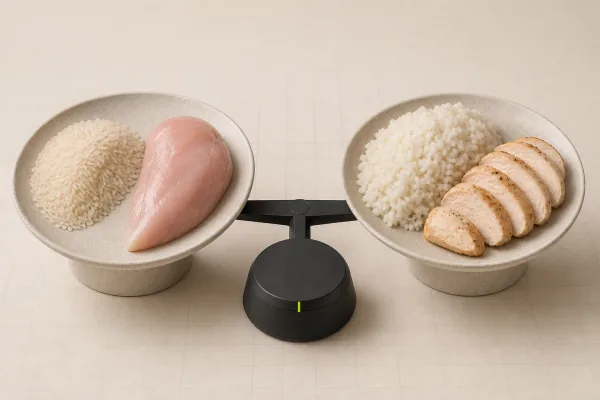
Read the guideThe best choice is not always raw. Accuracy mostly depends on matching the food state, nutrition entry, and portion you actually eat.
Read the guideA homemade recipe does not require a laboratory test: total its edible ingredients, measure the final yield, and allocate calories by serving weight.
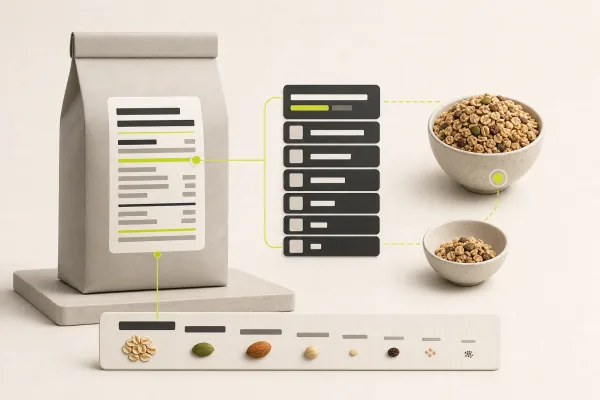
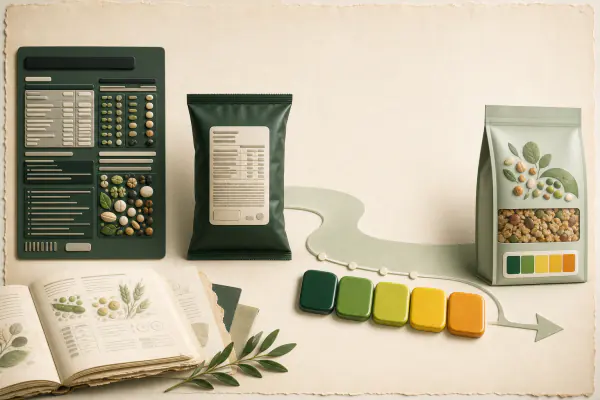
Read the guideA nutrition label becomes useful when you connect its reference amount to what you eat and compare products on the same basis.
Read the guideYou do not need an arbitrary body-fat cut-off. Clarify the priority, observe maintenance, and choose a measurable phase you can sustain.
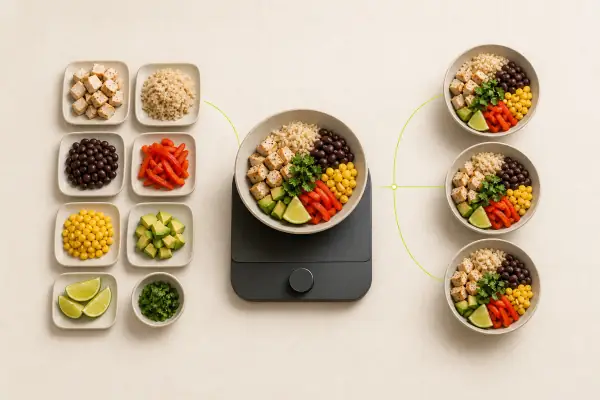
Read the guideA simple method for turning calorie targets into real meals, then adjusting based on average weight, performance, hunger, and digestion.
Read the guideSkip the magic meal plan and “dirty bulk.” Build modular meals, start with a conservative calorie surplus, and adjust it using three useful signals.
Read the guide“Eat big to get big” sounds logical, but rapid weight gain is not a direct measure of muscle growth. Here is where the idea came from and what the science supports.
Read the guideFoodvisor can make food logging easier, but a photo cannot measure portions perfectly. Here is how to evaluate the free version, Premium, and alternatives.
Read the guideYAZIO is a comprehensive nutrition tracker. Here is what it does well, what no app can guarantee, and when Nalko better fits a strength-training goal.
Read the guideCalories are not a daily verdict; they set an average direction. Learn how to manage energy balance with data that actually helps.
Read the guideNutri-Score summarizes a nutritional profile; NOVA classifies processing and formulation. The two perspectives can complement each other, but neither replaces serving size or the diet as a whole.
Read the guideNutri-Score summarizes a nutritional profile from A to E. It helps compare relevant alternatives, but it does not judge every aspect of a food or an entire diet.
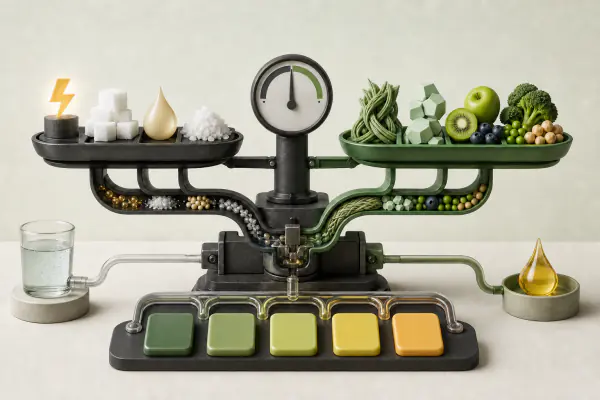
Read the guideThe calculation balances points for energy, sugars, salt, and saturated fat against points for fiber, protein, and plant-based ingredients, with several special rules.
Read the guideEffective in France since March 16, 2025, the updated algorithm better distinguishes several food categories, tightens certain thresholds, and scores beverages differently, with a two-year transition.
Read the guideThe logo helps people compare nutritional profiles quickly. Its effect on real purchases is more modest, and it cannot predict an individual’s health by itself.
Read the guideNova classifies foods by the nature and purpose of their processing. Its four groups describe formulation without grading nutritional quality or an individual’s risk by themselves.
Read the guideFormulated sodas, extruded snacks, and certain ready-to-eat meals are common examples, but classification depends on the actual recipe. Here are the useful clues and pitfalls.
Read the guideRaters without detailed guidance sometimes classify the same foods differently, while trained coders achieve much higher agreement. Here is what that tension does—and does not—show.
Read the guideHigh intake is associated with several health risks, and certain ultra-processed diets promote greater energy intake. The evidence does not make every Nova 4 product dangerous by itself.
Read the guideProtein bars, shakes and ready meals can make a gym diet look disciplined while hiding how repetitive it has become. Here is a measured audit, not a food-purity test.
Read the guideProtein on the front label does not cancel the formulation on the back. Classify carefully, then judge the product by its role, nutrition and place in the full diet.
Read the guideNOVA 4 food does not switch off hypertrophy. The practical issue is whether a convenient product supports your calorie, protein and training plan or displaces too much of the diet.
Read the guideDo not remove every bar, shake and ready meal overnight. Preserve the function of each food, make the easiest high-impact swaps, and measure the result.
Read the guideUse one protein anchor, one convenient energy source and fruit or vegetables. Ten repeatable assemblies beat a folder of recipes you never cook.
Read the guideA three-anchor method for allocating your full calorie budget without copying an arbitrary ratio or sacrificing performance.
Read the guideWhite bread, lentils, and oats all contain starch, but their food matrices differ. Here is why carbohydrate-chain length cannot tell you a food’s quality.
Read the guideSkip the laundry list of pills: use this food-based guide to cover vitamins, minerals, and fiber without treating every meal like an exam.
Read the guideGood timing depends less on the clock than on the gap between protein-rich meals, digestive comfort, and workout quality.
Read the guideBuild a sustainable deficit, preserve muscle, and judge the trend without extreme methods.
Depending on the training dose, cardio may lower scale weight more, while strength training protects what you do not want to lose. Here is how to move past the false choice.
Read the guideA soaked T-shirt and a lower number on the scale can make it feel as though you have “melted.” Here is what sweat actually reflects—and what to track instead.
Read the guideYogurts, bars, drinks, and meal-replacement packets promise more protein. Here is when they may support fat loss—and when they merely add calories and cost.
Read the guideA gradual, stigma-free path: medical assessment, health goals, sustainable nutrition, adapted activity, follow-up, and a limited role for digital tools.
Read the guideCalorie deficit, protein, resistance training, and tracking: a measurable method to gradually reduce your waist without a crash diet.
Read the guideThe right target starts with your current activity. Learn how to increase your steps without confusing movement, calories burned, and guaranteed fat loss.
Read the guideCalories near maintenance, enough protein, progressive resistance training, and consistent tracking: a practical body-recomposition protocol.
Read the guideBuild a realistic routine that survives low motivation and demanding weeks.
Workouts, meals, steps, and a backup plan: turn your physique goal into a routine simple enough to survive busy days and low motivation.
Read the guideA weigh-in measures far more than body fat. Learn what creates daily noise, how to standardize measurements, and when a trend deserves action.
Read the guideTime depends on cadence and the steps already built into your day. Two simple calculations turn 10,000 steps into a realistic schedule.
Read the guideA practical way to separate useful habits, performance measurements, watch estimates, and medical tests without collecting endless scores.
Read the guideCardiorespiratory fitness is one of the functional measures most strongly associated with longevity. But a hazard ratio neither promises extra years nor proves that the score itself is the cause.
Read the guideHRV describes variation in the time between heartbeats. It becomes most useful when the measurement protocol stays consistent and your personal trend replaces the verdict of one isolated number.
Read the guideA resting heart rate of 60–100 bpm is a common adult range, not a perfect target. Standardized measurements and your personal trend provide more context.
Read the guideObserve your routine, change one habit at a time, and assess its effect on your nights and workouts without chasing a perfect sleep score.
Read the guideSleep alternates between three non-REM stages and REM sleep. No single stage restores the body by itself; getting enough complete nights matters.
Read the guideOne to two hours is a rough descriptive range, not a universal goal. Total sleep duration, regularity, and symptoms matter more.
Read the guideSeparate evidence, practical value, and safety signals before buying or taking a supplement.
Use six filters before buying: a real constraint, evidence, safety, quality, cost, and a measurable outcome.
Read the guideTwo proceedings with different subjects: income claims and compensation in the United States, then corruption and accounting records in China.
Read the guideA factual review separating the OxyElite Pro liver-injury outbreak, the Jack3d and DMAA issue, and the criminal convictions for misbranding-related conduct.
Read the guideTwo distinct risks: the pharmacological effects of monacolins and an industrial contamination event limited to identified products.
Read the guideUnderstand what AI can adjust, which data it needs, and where human review remains essential.
Goals, comparable workouts, load, repetitions, and RIR provide the data needed for a measurable adjustment—not a brand-new program whenever progress gets difficult.
Read the guideCalories, macros, meals, and workouts: learn how an AI coach can turn consistent tracking into one targeted proposal without replacing a dietitian.
Read the guideA generated image can illustrate a physique, but it cannot track your sets or recovery. Learn how to use AI within a genuine progression process.
Read the guide